An international platform showcasing the world's highest-performing buildings — representing their countries and regions.
The World Championship for Energy Savings identifies and compares buildings based on measured reductions in energy consumption, not on design intent, labels or projections.
The Championship is built on a simple principle: only measured results count. Buildings are evaluated based on actual energy consumption data, comparing performance over time under real operating conditions. This creates a common ground for comparison across countries, asset types and market contexts.
The World Championship for Energy Savings (WCES) is a global initiative launched at COP30 in Belém by the Global Alliance for Buildings and Construction (Global ABC) and led by Action for Market Transformation (A4MT) to accelerate the global agenda to decarbonise the built environment, as framed by the Buildings Breakthrough, the Chaillot Declaration and the COP30 Action Agenda.
The championship culminates each year in an award ceremony at COP. At COP31, it will be held together with the YeS Honor Awards under the auspices of the International Sustainable Buildings Competition. The ceremony will be led by GlobalABC and hosted by the COP31 Presidency.
Ultimately, the WCES celebrates the buildings leading the race towards Near-Zero Emission and Resilient Buildings (NZERB) — the end goal the competition is driving towards.
Through the WCES, buildings become athletes and countries become teams, with measured performance as the only metric.
Rather than comparing means or ambitions, WCES highlight real, measured performance.
How performance is assessed depends on the building's pathway: Existing (OPEX) — relative energy savings (%); Renovated (CAPEX) — relative carbon-emissions reduction (%) via fuel-specific factors; New (NEW) — Budget Consumption Percentage against a climate-aligned energy budget. The objective is to reward real, measured operational performance. The metrics change for each performance pathway in order to recognise progress at every stage of a building's lifecycle.
30% of the energy used in buildings is wasted. If buildings in the 20 highest-emitting countries recovered just half of that waste, global emissions would drop by 5 %. So let's get it done.
Buildings are responsible for 34 % of global energy and process-related CO₂ emissions, 32 % of global energy demand and 50% of extracted resources. This pressure will keep growing as 50% of 2060 buildings are not yet built.
This means Buildings are a climate solution and an opportunity for the sector to reimagine the buildings of the future – while addressing the nexus with industry, social inequalities, energy security, health and biodiversity.
Policies exist.
Technologies exist.
Solutions exist.
But momentum is lacking.
NOW it is time to increase collaboration, align efforts and deliver a systemic, actionable Buildings Breakthrough.
Beyond recognition, the Championship serves as a pre-regulatory laboratory. By identifying what works in practice, it helps governments design performance-based policies grounded in real-world data. From proof to policy, from individual buildings to market transformation. The WCES transforms isolated success stories into collective momentum.
The World Championship for Energy Savings (WCES) is a global, performance-based initiative designed to accelerate energy efficiency in the built environment. It enables countries to establish national energy leagues, identify their top-performing buildings, and translate real-world performance into market transformation and policy insight.
WCES is built on a simple premise: only measured performance counts. Buildings are evaluated based on metered energy consumption, comparing performance over time under real operating conditions.
The Championship is structured around four key elements:
Assessment based on real energy consumption data
A common annual cycle aligning stakeholders and enabling comparability
Shared resources, knowledge exchange and capacity building across participants
Governance supported by a robust and transparent methodology
From national endorsement to international recognition, the WCES follows a clear and replicable process:
The WCES follows an annual cycle culminating at COP, where the highest-performing buildings are revealed and recognised:
Changing the approach to energy performance for the built environment will take the whole industry. Let's connect!
WCES is developed in collaboration with:
The platform:
Organisations can contribute by:
The WCES methodology provides a consistent framework to measure, compare and recognise energy performance across buildings, countries and market contexts.
Based on actual metered energy data
Ensuring fair comparison across buildings and contexts
Usable by a wide range of stakeholders
Aligned with recognised measurement practices
Applicable across countries and asset classes
The assessment focuses on operational energy consumption at building level.
National implementations may refine scope definitions to reflect local data availability and regulatory context.
Three pathways reflect where a building is in its lifecycle, each measured in the way that best captures real progress.
| Pathway | OPEX | CAPEX | NEW |
|---|---|---|---|
| Who falls into it | Existing buildings improved through operations — controls, scheduling, maintenance, occupant engagement — no major works. | Renovated / retrofitted buildings — deep refurbishment, envelope or system upgrades, and fuel switching. | Newly constructed buildings: no historical baseline, already optimised. |
| How it is evaluated, and why | Relative energy savings (%). Reference period data is used to make a baseline model (IPMVP Option C) that predicts expected use. The difference between predicted use in the monitoring period and measured use is the energy savings. | Relative emissions reduction (%). A renovation should also change the fuel mix, so emissions are measured to capture the full picture. The same model is used to compare predicted energy use and measured energy use, but the energy is converted to carbon equivalent emissions using each fuel's associated emissions factor. | Budget Consumption Percentage. An energy budget is derived using recognised decarbonisation pathways. Actual energy use is compared to this budget to see how close a building is to achieving net-zero targets. |
Existing buildings improved through operations — controls, scheduling, maintenance, occupant engagement — no major works.
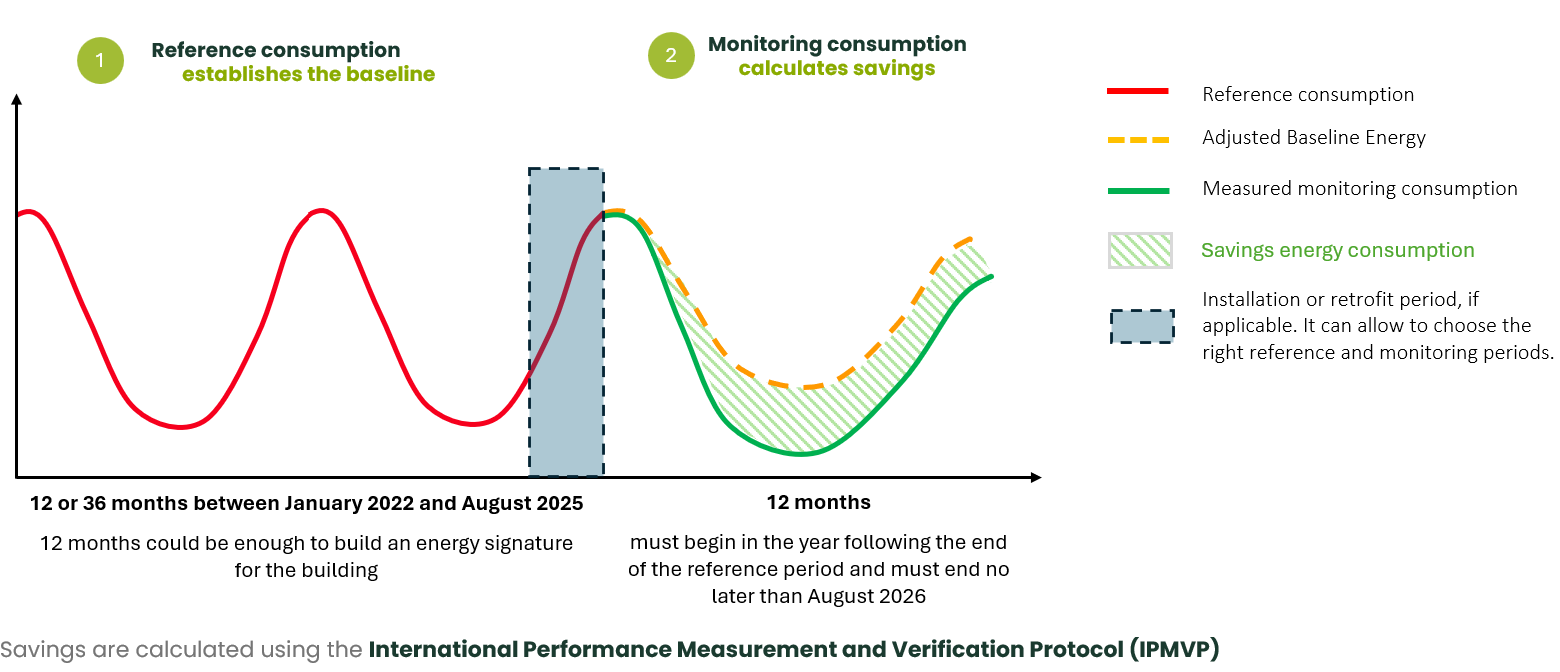
Relative energy savings (%). Reference period data is used to make a baseline model (IPMVP Option C) that predicts expected use. The difference between predicted use in the monitoring period and measured use is the energy savings.
Renovated / retrofitted buildings — deep refurbishment, envelope or system upgrades, and fuel switching.
Relative emissions reduction (%). A renovation should also change the fuel mix, so emissions are measured to capture the full picture. The same model is used to compare predicted energy use and measured energy use, but the energy is converted to carbon equivalent emissions using each fuel's associated emissions factor.
Newly constructed buildings: no historical baseline, already optimised.
Budget Consumption Percentage. An energy budget is derived using recognised decarbonisation pathways. Actual energy use is compared to this budget to see how close a building is to achieving net-zero targets.
OPEX and CAPEX performance are evaluated based on relative improvement (%). Case studies may also highlight absolute energy savings (kWh) and energy intensity indicators (e.g. kWh/m²), especially regarding new buildings.
The baseline reflects typical operation prior to improvement. The monitoring period captures actual performance under real conditions. Savings are calculated using the standard IPMVP Option C whole-building methodology.
Buildings are grouped into performance levels to ensure fair comparison. Each level reflects the magnitude of achieved energy savings, from moderate improvements to transformational reductions.
This structure allows both incremental progress and breakthrough performance to be recognised.
Data submission is based on metered energy consumption. Data is self-reported and should be supported by documentation (e.g. energy bills) to be verified by the A4MT.
The methodology is designed as an evolving framework. It is refined over time based on:
Every building enters the same way and climbs the same ladder. Recognition is progressive (i.e. the number who reach each level decreases every step):
Buildings are only ever compared with others in similar conditions, grouped by the Köppen-Geiger system into four regions:
This year, the WCES' final awards are presented as part of the International Sustainable Buildings Competition, led by GlobalABC and the COP31 Presidency, at COP31 in Antalya, Türkiye. Only Climate Region Champions qualify, and the GlobalABC Jury makes the final selection. For this stage, Climate Region Champions are grouped into ten award categories — by activity (Office or Other Buildings), climate (Cool or Hot) and pathway (OPEX, CAPEX or NEW) — and one World Champion is named per category based on GlobalABC jury deliberation.
| Cool Climate | Hot Climate | New Build | |||
|---|---|---|---|---|---|
| Office | OPEX | CAPEX | OPEX | CAPEX | NEW |
| Other | OPEX | CAPEX | OPEX | CAPEX | NEW |
= 10 categories total (Office: 4 climate-pathway + 1 NEW; Other: 4 + 1). The NEW category is not split by climate.